New Services, Greater Income
More DetailsInfo@reliancecapitalfinancelimited.com
R e l i a n c e C a p i t a l
F i n a n c e L i m i t e d
Info@reliancecapitalfinancelimited.com
New Services, Greater Income
More Details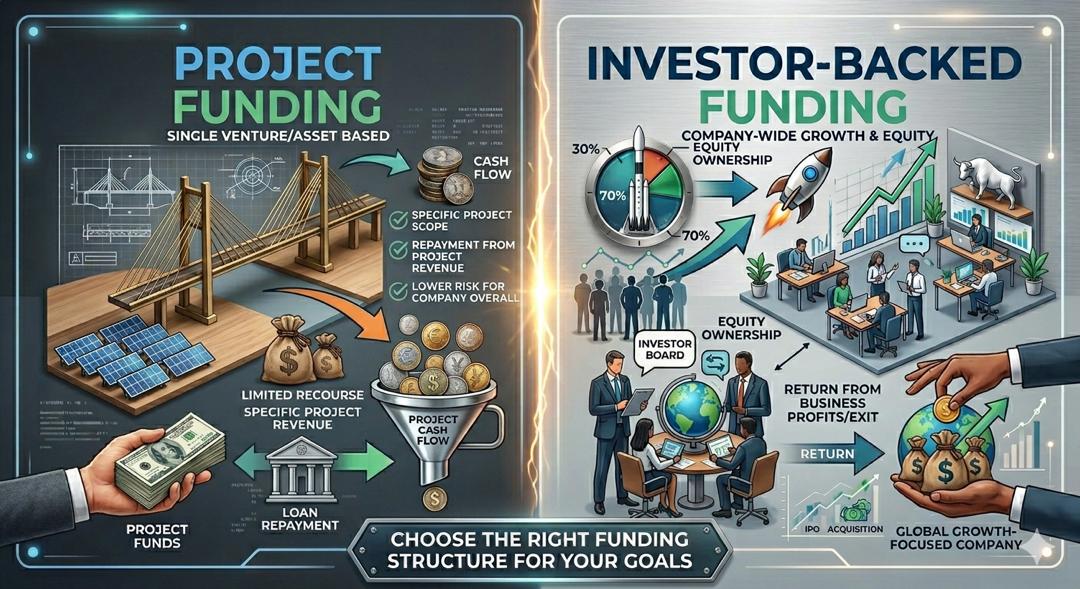
Project Funding Vs Investor-Backed Funding In today’s financial environment, access to capital determines whether a business project survives or disappears from the market. Companies across construction, manufacturing, energy, technology, logistics, agriculture, and international trade continuously seek financing solutions capable of supporting expansion, operational continuity, and long-term profitability. Yet many entrepreneurs still struggle to identify the difference between Project Funding and Investor-Backed Funding.
Although both financing models provide access to capital, their structure, risk allocation, repayment expectations, and strategic influence differ significantly. Therefore, understanding the distinction between these financial systems becomes essential for organizations seeking sustainable growth and stronger financial positioning.
At Reliance Capital Finance Limited, modern financial structuring continues to evolve as businesses search for more flexible and scalable funding solutions capable of supporting global commercial activities.
Project Funding refers to a specialized financing arrangement designed specifically for a particular project rather than for the overall company itself. Under this structure, lenders or financial institutions evaluate the project’s future cash flow, projected revenue, feasibility studies, assets, contracts, and operational strength before approving financing.
This funding model is commonly used in:
In most cases, the project itself becomes the primary security for the financing arrangement. Consequently, lenders focus heavily on overall project performance, projected revenue generation, financial stability, risk assessment, and the long-term commercial viability of the investment before approving funding solutions.
Project Funding often involves:
Because of its structured financial nature, Project Funding normally suits organizations managing high-value commercial developments, infrastructure projects, and large-scale investments that require substantial capital injection and long-term financial planning.
Investor-Backed Funding operates differently. Instead of relying primarily on project-generated revenue, this financing structure depends on private investors, venture capital firms, institutional partners, angel investors, or strategic financial stakeholders willing to provide capital in exchange for ownership interest, profit participation, or future returns.
Under this model, investors place capital into a business because they believe in its growth potential, long-term profitability, operational strength, market opportunities, and overall ability to generate sustainable financial returns.
Investor-Backed Funding may involve:
Unlike traditional lending structures, investor-backed financing may not always require immediate repayment schedules. Instead, investors expect returns through business growth, market expansion, or future valuation increases.
As a result, startups and rapidly growing enterprises often prefer investor-backed financing because it provides greater financial flexibility, easier access to growth capital, and fewer restrictions compared to traditional lending conditions.
The central distinction lies in the source of financial confidence.
In Project Funding, confidence comes from the project’s projected success and cash flow generation capacity. In Investor-Backed Funding, confidence comes from the investors’ belief in the company’s future market value and management capability. This difference creates separate operational structures, financial responsibilities, risk profiles, investment strategies, and long-term business consequences for all parties involved.
Project Funding Focuses On:
Investor-Backed Funding Focuses On:
Therefore, companies must carefully understand their operational goals, financial requirements, growth strategies, and long-term business objectives before selecting either financing pathway.
Risk management remains one of the most important factors within commercial finance because it helps businesses minimize financial losses, control operational uncertainty, maintain investment stability, and protect long-term business sustainability.
Under Project Funding, financial risk often stays attached to the project itself. If the project underperforms, lenders may recover potential losses through project assets, contractual guarantees, collateral arrangements, insurance coverage, or other structured legal protections established within the financing agreement.
Consequently, lenders conduct extensive financial due diligence, project evaluation, risk assessment, legal verification, and commercial analysis before approving large-scale financing arrangements.
Investor-Backed Funding distributes risk differently. Investors willingly accept higher uncertainty because they anticipate higher returns in the future. Therefore, investors may tolerate temporary losses, slower expansion periods, or early-stage operational instability.
However, this flexibility usually comes with increased investor influence over company decisions, business operations, financial strategies, corporate governance, and long-term organizational direction.
Project Funding generally allows companies to maintain operational ownership because lenders primarily expect repayment with interest rather than company control. As long as repayment obligations remain satisfied, management authority stays largely within the organization.
Investor-Backed Funding, however, may reduce ownership concentration.
Investors often request:
As investment levels increase, external influence over corporate decisions may also expand. For some companies, this partnership accelerates growth. For others, it creates governance complexity and reduced executive independence.
Therefore, leadership teams must carefully evaluate the long-term implications before accepting investor-driven capital structures.
Project Funding offers strong scalability for large infrastructure and industrial developments. Because financing aligns directly with project cash flow projections, organizations can secure significant capital for long-duration developments.
This structure becomes highly valuable in sectors requiring:
Investors may support:
Moreover, investor-backed financing can move faster than traditional project-based approvals because investment decisions often rely heavily on market opportunity and leadership confidence.
The answer depends entirely on business objectives, operational maturity, and capital requirements.
Project Funding May Be Better For:
Investor-Backed Funding May Be Better For:
Nevertheless, modern financial markets increasingly combine both structures into hybrid financing systems.
For example, a company may use investor-backed capital during early expansion stages before transitioning into project-based financing for large infrastructure deployment. This blended approach improves financial diversification while reducing concentrated funding dependency.
Today, businesses seek funding systems capable of supporting cross-border trade, technological modernization, and accelerated commercial scalability.
Several modern trends now influence both Project Funding and Investor-Backed Funding:
As financial systems become increasingly interconnected, companies capable of understanding advanced financing structures gain stronger competitive positioning within international markets.
Therefore, financial literacy no longer remains optional for modern business leadership. It has become a strategic necessity.
Proper financing structure selection affects more than immediate capital access.
It influences:
Organizations that misunderstand financing structures often experience repayment pressure, ownership disputes, operational instability, or expansion failure. However, businesses that align financing strategy with long-term commercial objectives position themselves for stronger financial endurance and scalable success.
This explains why professional financial advisory services continue gaining importance across global markets.
Project Funding and Investor-Backed Funding both provide powerful financial opportunities. Yet they serve fundamentally different strategic purposes.
Project Funding emphasizes structured repayment, asset-backed security, and project-generated revenue strength. Meanwhile, Investor-Backed Funding prioritizes growth potential, scalability, innovation, and long-term business value creation.
Neither financing structure is universally superior.
The ideal solution depends on:
As global finance continues transforming, businesses capable of selecting the appropriate funding structure will maintain stronger adaptability, operational resilience, and market expansion capacity. Under modern commercial conditions, strategic financing no longer represents merely a support mechanism for business operations.
Get InTouch with Us today for your Global Project Funding.
Email: info@reliancecapitalfinancelimited.com