New Services, Greater Income
More DetailsInfo@reliancecapitalfinancelimited.com
R e l i a n c e C a p i t a l
F i n a n c e L i m i t e d
Info@reliancecapitalfinancelimited.com
New Services, Greater Income
More Details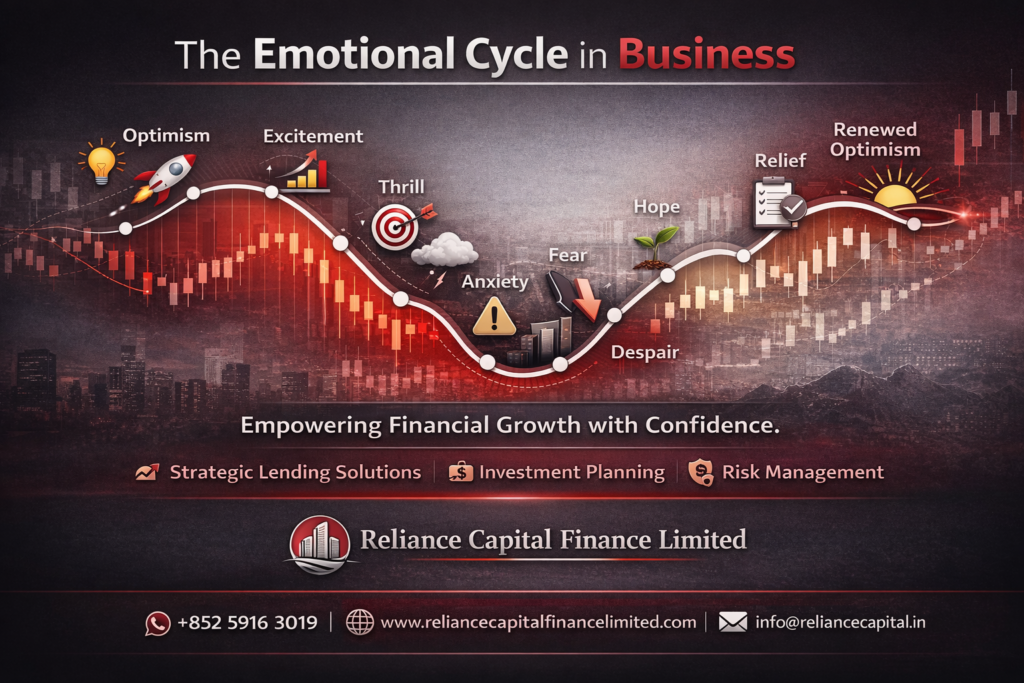
Understanding business is not only about numbers, capital allocation, or strategic execution. Instead, it is equally about mastering the psychological and emotional patterns that influence decision-making. Therefore, the concept of the emotional cycle in business becomes essential for entrepreneurs, investors, and financial managers who aim to achieve sustainable success. This cycle reflects how emotions evolve throughout different stages of a business journey, and consequently, how those emotions impact financial outcomes.
At the beginning of any business initiative, optimism naturally dominates. Entrepreneurs feel confident about their ideas, while investors anticipate strong returns. Moreover, market conditions often appear favorable, which further strengthens this positive outlook.
At this stage, individuals tend to focus on opportunities rather than risks. As a result, financial projections may appear overly ambitious. However, optimism is necessary because it fuels innovation, encourages risk-taking, and drives initial capital investment. Without it, most ventures would never begin.
Nevertheless, maintaining financial discipline during this phase is critical. Although confidence is high, structured planning and realistic forecasting must still guide decision-making.
As the business begins to generate results, excitement replaces initial optimism. Revenue streams start forming, customer engagement increases, and operational systems begin to stabilize. Consequently, stakeholders feel validated in their decisions.
At this point, financial inflows create a sense of momentum. Furthermore, expansion opportunities—such as scaling operations or entering new markets—become attractive. Because of this, many businesses increase spending, invest in marketing, and pursue rapid growth strategies.
However, excitement can lead to overconfidence. Therefore, it is essential to balance enthusiasm with financial analysis. Sustainable growth depends on careful budgeting, cash flow management, and risk assessment.
Following excitement, businesses often enter the thrill phase. This stage is characterized by peak confidence and aggressive expansion. Profits may be at their highest, and decision-makers feel nearly invincible.
Companies may take on larger financial commitments, including loans, partnerships, or major capital investments. While these decisions can accelerate growth, they also increase exposure to risk.
Within this phase, strategic financial institutions and advisory firms play a vital role. For instance, companies like Reliance Capital Finance Limited provide structured financial solutions that help businesses expand responsibly. Rather than relying purely on emotional confidence, such institutions introduce disciplined frameworks for capital deployment and risk mitigation.
Eventually, market realities begin to shift. Growth may slow, competition may intensify, or external economic factors may introduce uncertainty. Consequently, the emotional state transitions from thrill to anxiety.
At this stage, business leaders start questioning earlier decisions. Financial pressures may arise, particularly if expansion was funded through debt or aggressive spending. Therefore, cash flow management becomes increasingly critical.
Although anxiety can be uncomfortable, it serves a valuable purpose. It encourages reassessment, promotes caution, and highlights potential vulnerabilities within the business model. Thus, businesses that respond proactively can stabilize their operations and avoid deeper financial distress.
If challenges persist, anxiety often develops into fear. Revenue may decline, operational costs may remain high, and financial obligations may become more difficult to meet. As a result, decision-makers may hesitate, delay actions, or adopt overly conservative strategies.
During this phase, emotional decision-making can become dangerous. Fear may lead to missed opportunities, poor investments, or reactive cost-cutting measures that harm long-term growth.
Therefore, structured financial guidance becomes essential. By applying analytical tools, businesses can evaluate risks objectively. Additionally, working with experienced financial partners helps organizations navigate uncertainty with clarity rather than emotion.
In some cases, prolonged fear leads to despair. This stage represents the lowest emotional point, where confidence is minimal and financial strain is most intense. Businesses may face significant losses, declining market share, or operational instability.
At this point, many organizations consider restructuring, downsizing, or even exiting the market. However, despair also presents an opportunity for transformation. By conducting a thorough financial review, businesses can identify inefficiencies, eliminate unnecessary costs, and rebuild stronger foundations.
Importantly, resilience during this phase often determines long-term success. Companies that endure and adapt frequently emerge more efficient and strategically aligned.
After reaching the lowest point, businesses begin to recover. Small improvements—such as stabilized revenue, reduced costs, or improved customer engagement—restore a sense of hope.
This phase is gradual and requires patience. Financial discipline becomes a priority, and decision-making shifts toward sustainability rather than rapid growth. Consequently, businesses rebuild confidence step by step.
Moreover, lessons learned from earlier stages influence future strategies. Organizations become more cautious, more analytical, and more resilient.
As recovery continues, relief replaces uncertainty. Financial performance improves, operational systems stabilize, and risks become more manageable.
At this stage, businesses often reflect on past experiences. They analyze what worked, what failed, and how emotional decision-making influenced outcomes. Therefore, relief is not just about stability—it is also about learning.
Companies that integrate these lessons into their financial strategies are better prepared for future cycles. They develop stronger risk management frameworks, improve forecasting accuracy, and maintain balanced growth approaches.
Finally, the cycle returns to optimism. However, this optimism is different from the initial stage. It is now informed by experience, supported by data, and guided by financial discipline.
Businesses enter new opportunities with a more balanced perspective. They remain confident, yet cautious. As a result, they are better equipped to navigate future emotional cycles without extreme volatility.
Understanding the emotional cycle in business is not merely theoretical—it has direct financial implications. Each stage influences decision-making, investment behavior, and risk tolerance. Therefore, recognizing these patterns allows businesses to act strategically rather than react emotionally.
For example, during periods of excitement or thrill, maintaining financial controls prevents overexpansion. Conversely, during fear or despair, objective analysis helps avoid panic-driven decisions. In both cases, emotional awareness enhances financial stability.
Additionally, integrating professional financial support ensures consistency across all stages. Structured lending, investment planning, and risk management services provide a stable foundation, regardless of emotional fluctuations.
In conclusion, the emotional cycle in business is an inevitable part of every entrepreneurial journey. While emotions drive innovation and ambition, they can also introduce risk if left unmanaged. Therefore, the key to long-term success lies in balancing emotional awareness with financial intelligence.
By understanding each stage—optimism, excitement, thrill, anxiety, fear, despair, hope, relief, and renewed optimism—business leaders can make more informed decisions. Furthermore, by applying disciplined financial strategies, they can navigate challenges with confidence and precision.
Ultimately, businesses that master this balance do not merely survive cycles—they leverage them. As a result, they achieve sustainable growth, stronger resilience, and consistent financial performance in an ever-evolving market environment.
Reliance Capital Finance Limited:
WhatsApp: +852 5916 3019
Website: www.reliancecapitalfinancelimited.com
Email: info@reliancecapitalfinancelimited.com
For professional financial guidance, structured lending solutions, and strategic investment support, reach out to Reliance Capital Finance Limited to help you navigate every stage of the business emotional cycle with confidence and financial clarity.