New Services, Greater Income
More DetailsInfo@reliancecapitalfinancelimited.com
R e l i a n c e C a p i t a l
F i n a n c e L i m i t e d
Info@reliancecapitalfinancelimited.com
New Services, Greater Income
More Details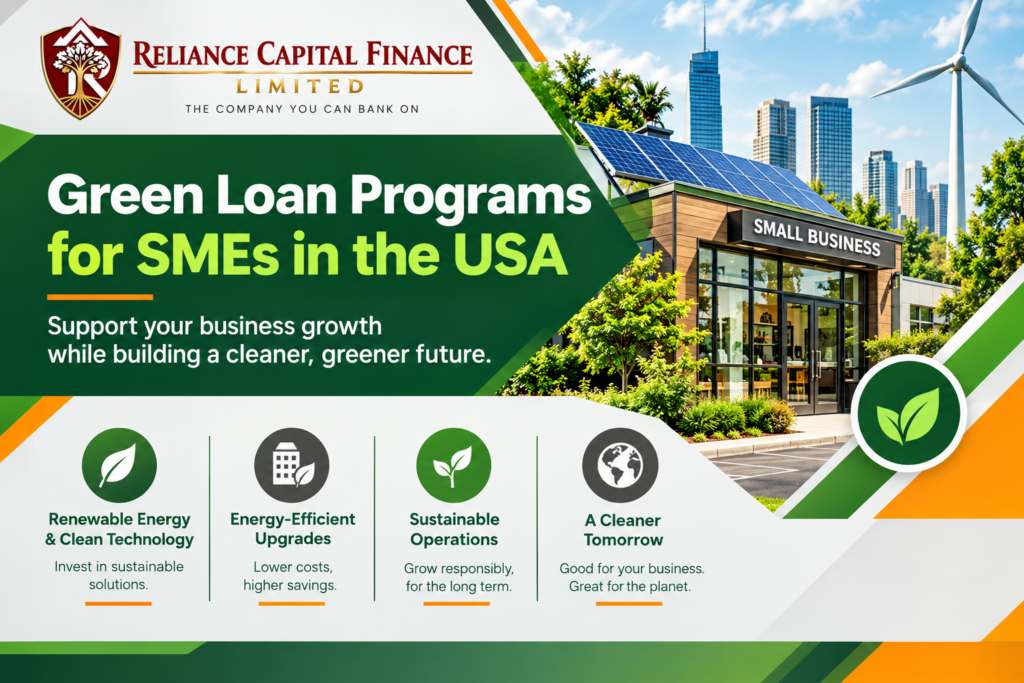
Green loan Programmed for SMEs in the USA can help small and medium-sized businesses finance projects that improve energy efficiency, renewable energy use and environmental performance. These programmed can support investments such as solar systems, efficient equipment, building improvements, clean technology and other energy-saving projects. The US Department of Energy notes that businesses can use different financing structures, including loans, leases, on-bill financing and energy-as-a-service arrangements.
For an SME, the main benefit is that a business may be able to make an environmental improvement without paying the entire project cost upfront. However, eligibility, interest rates, repayment terms and available funding vary between programmed and locations.
Green loan programmed provide financing for projects with defined environmental or energy-related benefits. A business might borrow money to replace old equipment with more efficient machinery, install renewable energy systems or improve the performance of its commercial property.
The US Department of Energy’s Better Buildings initiative identifies commercial loans, leases, Property Assessed Clean Energy (PACE), energy-as-a-service and energy savings performance contracts among the financing options available for energy projects.
Some programmed are available across the United States, while others operate only in particular states or utility service areas. Therefore, an SME should check local requirements before selecting a financing option.
Energy-efficiency loans can help businesses fund improvements that reduce energy consumption. Projects may include efficient lighting, heating and cooling systems, insulation, machinery and building upgrades.
The Department of Energy provides information on state and local energy loan funds. Its resources identify programmed in several states, including small-business energy-efficiency loan programmed.
SMEs may also seek financing for renewable-energy projects. Solar power is one common example. Depending on the location and programmed, a business may combine financing with available incentives, rebates or other support.
The DOE Better Buildings Financing Navigator is designed to help organizations explore financing options for energy-efficiency and renewable-energy projects.
On-bill financing or repayment allows a business to repay certain energy-project costs through its utility bill. These programmed are not available everywhere, because participation depends on the local utility and programmed structure.
The DOE states that on-bill programmed can support energy-efficiency and renewable-energy projects, with some programmed offering low or zero-interest financing.
Agricultural producers and rural small businesses may have access to additional federal programmed. The Department of Energy identifies the USDA Rural Energy for America Program (REAP) as providing support for energy audits and renewable-energy development for agricultural producers and rural small businesses.
This can be relevant to SMEs operating farms, food-processing businesses and other rural enterprises.
The federal government also operates larger clean-energy financing programmed. For example, the DOE Loan Programs Office administers loan-guarantee programmed for eligible clean-energy projects. Some programmed can include small businesses among eligible recipients, although individual projects must meet specific requirements.
In addition, the DOE and US Small Business Administration established the Small Business Investment Company-Energy (SBIC-E) Initiative in August 2026. The initiative is intended to encourage private investment in small businesses working in areas such as energy technology, advanced manufacturing and supply-chain resilience.
These programmed should not be confused with a standard small-business loan. Each has its own eligibility rules, application process and investment structure.
Before applying for green financing, an SME should prepare a clear project proposal. The proposal should explain what the business plans to finance, the estimated cost and the expected business and environmental benefits.
Useful information may include:
A clear financial plan can help lenders understand the project’s costs and repayment capacity.
Reliance Capital Finance Limited can be positioned within the wider financial-services sector as a potential source of financial guidance for businesses exploring business, project and investment-related financing.
However, SMEs should distinguish between private financial assistance and government-backed programmed. A relationship with a financial company does not automatically mean that a business qualifies for a US government programmed.
Applicants should verify the programmed administrator, eligibility conditions, fees, documentation requirements and financing terms before making any financial commitment.
Green financing can support both environmental improvements and business development. Energy-efficient equipment, for example, may reduce energy consumption, while renewable-energy investments may change the way a business manages its long-term energy costs.
Furthermore, green investment can help SMEs modernize their operations and respond to growing demand for sustainable products and services.
The DOE also notes that financing can help overcome the upfront cost barrier that often prevents organizations from carrying out energy-efficiency and onsite-generation projects.
Green loan programs for SMEs in the USA offer several potential ways for small and medium-sized businesses to finance energy efficiency, renewable energy and other sustainable improvements. Options can include commercial loans, state and local energy programmed, on-bill financing, rural energy programmed and selected federal financing initiatives.
The right option depends on the business, project location, financing requirement and eligibility criteria. SMEs should therefore compare the applicable terms carefully, prepare strong documentation and verify information directly with the relevant programmed administrator.
With proper planning, green financing can help American SMEs invest in cleaner technology, improve operational efficiency and build stronger businesses for the future.