New Services, Greater Income
More DetailsInfo@reliancecapitalfinancelimited.com
R e l i a n c e C a p i t a l
F i n a n c e L i m i t e d
Info@reliancecapitalfinancelimited.com
New Services, Greater Income
More Details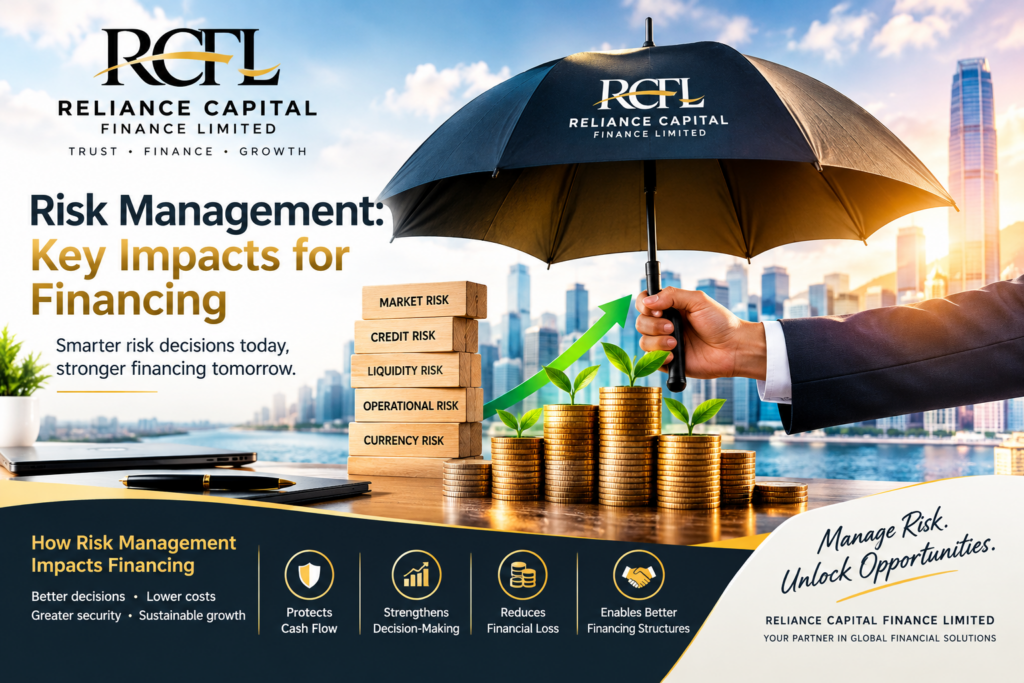
Risk management is one of the most important foundations for making sound financing decisions. Whether a business is seeking working capital, project finance, trade finance, investment funding, or a structured financial facility, understanding and managing risk can significantly influence the success of the financing process.
Financial markets continue to change because of economic uncertainty, interest-rate movements, inflation, currency fluctuations, regulatory requirements, technological developments, and changing customer demand. Consequently, businesses and financial institutions need practical strategies that help identify potential risks before they become expensive problems.
For companies seeking financing, effective risk management can improve financial stability, strengthen decision-making, protect assets, and support long-term growth.
Risk management in financing refers to the process of identifying, assessing, controlling, monitoring, and reducing financial risks that could affect a borrower, lender, investor, or project. Before providing financing, financial institutions may examine several factors, including the borrower’s financial position, repayment capacity, business model, market conditions, existing obligations, collateral where applicable, and the purpose of the requested funding.
The objective is not necessarily to eliminate every risk. Instead, effective risk management focuses on understanding risk and establishing appropriate measures to manage it.
For example, a company requesting financing for a major construction project may face risks related to construction costs, currency movements, delays, market demand, interest rates, and cash flow. A well-designed risk-management framework helps identify these areas before financing is committed.
Risk management plays a central role in determining how financing decisions are structured. It can influence the cost, terms, conditions, duration, security requirements, and repayment structure of a financial facility.
For borrowers, stronger risk management can demonstrate that the business understands its financial responsibilities and has considered potential challenges. For lenders and investors, risk analysis provides a framework for assessing whether the proposed financing is appropriate for the underlying project or business.
Therefore, risk management creates a bridge between financing opportunities and financial responsibility.
One of the most important impacts of risk management is better decision-making.
Before financing is approved, risk assessment can help determine whether a business or project has sufficient financial strength to support the proposed facility. This may involve reviewing revenue, expenses, cash flow, debt obligations, business performance, and projected financial results.
By examining these factors, financing decisions can become more structured and evidence-based.
Cash flow is critical to every business. Even profitable companies can experience financial pressure when money enters the business more slowly than expected.
Risk management helps businesses identify potential cash-flow gaps and prepare appropriate strategies. These strategies may include maintaining liquidity reserves, managing payment schedules, diversifying revenue sources, and matching financing terms with expected cash-flow cycles.
Consequently, effective cash-flow risk management can help businesses meet their financial obligations more consistently.
Financial risks can arise from unexpected events. Currency depreciation, rising borrowing costs, declining demand, delayed payments, or project cost increases can affect a company’s ability to meet its obligations.
A strong risk-management strategy identifies these vulnerabilities early and establishes measures to reduce their potential impact.
For example, a company involved in international trade may face foreign exchange risk when revenues and expenses are denominated in different currencies. Understanding this exposure allows the company to plan its financing and payment strategy more carefully.
Not every financing requirement should use the same structure.
A short-term working-capital requirement may require a different solution from a long-term infrastructure project. Similarly, trade finance, equipment finance, project finance, and investment financing each involve different risks and financial considerations.
Risk management helps determine the appropriate structure by examining the purpose, duration, cash-flow profile, and risk characteristics of the financing requirement.
This distinction is important because the right financing structure should correspond with the underlying financial need.
Risk management generally involves several connected functions:
Risk Identification:
The first step is determining what could negatively affect the financing arrangement. Risks may include credit risk, market risk, liquidity risk, operational risk, currency risk, interest-rate risk, and regulatory risk.
Risk Assessment:
After identifying potential risks, the next step is evaluating their potential likelihood and financial impact.
Risk Mitigation:
Businesses can then introduce measures designed to reduce exposure. Depending on the situation, these may include diversification, stronger contracts, insurance, liquidity planning, appropriate collateral, hedging strategies, or revised financing structures.
Risk Monitoring:
Risk management does not end when financing is approved. Financial conditions can change, so businesses should continue monitoring performance, cash flow, market conditions, and obligations.
Risk Reporting:
Clear financial reporting helps management, lenders, and other stakeholders understand emerging risks and make timely decisions.
Understanding the Difference Between Major Financial Risks
Different financial risks affect financing in different ways.
Credit Risk
Credit risk is associated with the possibility that a borrower or counterparty may fail to meet its financial obligations.
It is particularly important when evaluating loans, credit facilities, trade finance arrangements, and other forms of financing.
Market Risk
Market risk relates to changes in market conditions, including interest rates, currency exchange rates, commodity prices, and other financial variables.
For businesses operating internationally, market risk can become particularly important because changes in exchange rates may affect revenues, costs, and debt obligations.
Liquidity Risk
Liquidity risk occurs when an individual or organization does not have sufficient readily available funds to meet financial obligations when they become due.
Strong liquidity planning can therefore be essential for maintaining business continuity.
Operational Risk
Operational risk can result from failures in internal processes, systems, technology, personnel, or procedures.
Although it may appear different from traditional financial risk, operational problems can ultimately create significant financial consequences.
For businesses exploring financing opportunities, understanding risk should be part of the process from the beginning rather than an afterthought.
Reliance Capital Finance Limited can position its financing discussions around the importance of understanding a client’s objectives, financial requirements, project characteristics, and relevant risks. This approach helps create clearer conversations between financing providers and businesses seeking capital.
Whether the requirement involves business financing, project funding, trade-related financial solutions, or other structured financial needs, risk considerations can help determine the appropriate approach.
The broader principle is simple: financing should be considered alongside financial capacity, obligations, project objectives, and potential risks.
Effective risk management is not only about preventing losses. It can also support sustainable growth. When businesses understand their financial exposure, they can make more informed decisions about expansion, investment, borrowing, and capital allocation.
For example, a growing company may want to enter a new international market. Instead of focusing only on the potential revenue, management should also consider currency exposure, customer payment risk, regulatory requirements, supply-chain risks, and additional financing requirements.
This balanced approach allows businesses to consider opportunities while remaining aware of potential challenges.
Before accepting or pursuing financing, businesses should consider several important questions:
Answering these questions can provide a stronger foundation for responsible financial planning.
Risk management is a key component of successful financing. It helps businesses understand financial exposure, protect cash flow, evaluate potential challenges, and make more informed financing decisions.
The difference between simply obtaining financing and managing financing responsibly is significant. A business that understands its risks is better positioned to plan its obligations, evaluate opportunities, and respond to unexpected financial changes.
As global markets continue to evolve, risk management will remain an essential part of responsible financial decision-making. Businesses, investors, and financing providers can all benefit from treating risk assessment as an ongoing process rather than a one-time exercise.
For organizations considering financing, the goal should not simply be to obtain capital. The goal should be to understand how the financing works, what risks it creates, how those risks can be managed, and how the facility supports the organization’s broader financial objectives.
For more information about financial solutions and financing opportunities, contact Reliance Capital Finance Limited through its official communication channels.
Website: reliancecapitalfinancelimited.com
Email: info@reliancecapitalfinancelimited.com