New Services, Greater Income
More DetailsInfo@reliancecapitalfinancelimited.com
R e l i a n c e C a p i t a l
F i n a n c e L i m i t e d
Info@reliancecapitalfinancelimited.com
New Services, Greater Income
More Details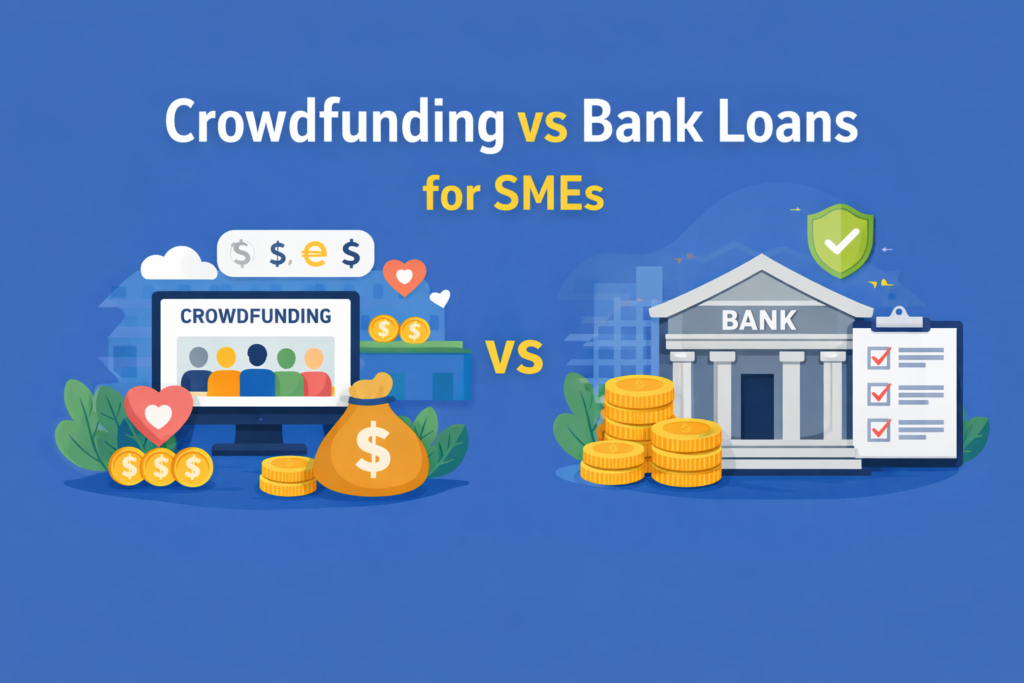
Crowdfunding vs Bank Loans Small and medium-sized enterprises (SMEs) are the backbone of modern economies. They make up over 95% of businesses worldwide and generate more than 60% of total employment. Despite their importance, many SME owners still struggle to access reliable and consistent funding.
According to the World Bank and the International Finance Corporation (IFC), the global gap in financing for SMEs is around $5.8 trillion. This gap leaves millions of businesses unable to get the money they need to grow, hire people or invest in new ideas.
For many years, the primary means of borrowing money was through the banks for SMEs. But banks require strict collateral, lengthy approval times and the cost of borrowing is very high.
As a result, many growing businesses have difficulty getting the loans they need.
Nowadays, new alternatives have emerged, such as crowdfunding and digital finance like Reliance. These allow founders to fundraise directly from their investors and their communities through an online media.
This change has given rise to a new option, where SME owners must decide between traditional bank loans or modern crowdfunding mechanisms. Each choice has its own strengths and weaknesses and there are different rules to follow.
Knowing how the two models work and how they compare on cost, speed, and regulations makes it easier for owners to choose the best way to facilitate steady growth.
Crowdfunding can serve as a valuable source of finance to small and medium enterprises, particularly due to the accessibility of online service providers that facilitate the coordination of business owners and investors.
Rather than relying on a single lender, a business is able to raise funds through the contributions of many individuals who provide small amounts. The model is a popular one that has gained popularity over the past few years.
According to the global alternative finance market, such as crowdfunding, has grown a lot since small and medium-sized businesses want money that is not from traditional banks.
There is no single model of crowdfunding. It has a number of structures that have various purposes for businesses and investors.
It allows investors to purchase stock in a company in exchange for their money. The shareholders get an opportunity to be part owners and may receive dividends or gains in case the company expands. Many startups use it to raise funds without incurring debt.
It refers to peer to peer (P2P) lending, which functions similarly to a conventional loan. Investors become stakeholders and lend their funds to the business and earn interest or profit after some time. Online marketplaces connect investors with the business owners who have a desire to lend money and the websites help make the connection.
It is usually for helping people, creative projects or work for the community. The donors provide funds without any intention of gaining financial compensation. The commercial SMEs are less likely to use it, though some will make use of it when introducing products or community projects.
These models show that crowdfunding may be flexible, allowing businesses to choose the structure that suits their funding requirements as well as their goal regarding how they acquire growth.
Crowdfunding has provided a number of realistic advantages to SMEs seeking funds without relying on traditional banks. Many entrepreneurs use it to raise capital and test their business ideas in the market.
The reason that makes crowdfunding available is that it is more about the business idea, the team and the market potential than the physical assets. This assists small businesses that find it difficult to meet bank collateral requirements.
Whenever individuals put their money in a crowdfunding initiative, they express an interest in the service or product. Such support at an early age assists the entrepreneurs in testing the demand prior to expansion.
Crowdfunding allows more people to know about a product. Companies also run these campaigns online, allowing them to reach both investors and customers more effectively. If a campaign is successful, it will often create a pool of loyal customers before the product is launched.
In such markets, government bodies such as HKMA and HKSAR have also come up with regulations on the crowdfunding sites. Such regulations secure the investors and foster confidence in online funding.
Although crowdfunding offers alternative methods intended to enable SMEs to access funding, it also comes with its own risks that should be familiar to the owners.
One key difference between crowdfunding and bank loans is the level of certainty in receiving funds.
Crowdfunding depends heavily on public interest and the participation of a large number of supporters. If a campaign fails to attract enough backers or does not reach its funding target, the business may receive little or no funding at all. In many cases, crowdfunding platforms operate on an all-or-nothing model, meaning funds are only released if the full target amount is achieved within the set timeframe.
In contrast, bank loans provide a more predictable outcome once approval is granted. If a business meets the lending requirements and is approved, the agreed loan amount is disbursed, giving the business more certainty in planning and execution.
Businesses share information about their product, plans, and strategy to attract investors. However, this public exposure also allows competitors to see the idea and potentially develop a similar product.
Regulatory and compliance requirements are an important consideration when comparing crowdfunding and bank loans.
Crowdfunding platforms are subject to strict regulations in many countries to protect investors and ensure transparency. For example, in regions such as the UAE and Hong Kong, platforms must comply with rules set by financial authorities such as the HKMA (Hong Kong Monetary Authority) and the HKSAR government framework.
These regulations typically require clear risk disclosures, operational transparency, and proper investor protection measures to ensure that participants fully understand the risks involved in funding campaigns.
In contrast, bank loans are also highly regulated but operate under a more traditional financial framework. Banks must follow established lending rules, credit assessment standards, and financial reporting requirements before issuing loans to businesses.
With equity crowdfunding, returns go to the investors in the form of shares. The founders will have to surrender a portion of ownership and possibly will have less control over decisions in the future.
When a business publicly raises funds, it will increases the expectations. If the project faces any failure or delay, it may harm the reputation and trust of the company with investors and customers.

For many years, small and medium businesses (SMEs) obtained funding through bank loans or private lenders, which are a primary source of funding for businesses. Banks provide funds that companies use for their daily operations, equipment purchases or expansion processes. In the HK, the government and banks try to make it easier for small and medium size enterprise to get loans.
The HK Ministry of Economy notes that SMEs represent approximately 90% of all companies and provide over 60% of the country’s GDP. Because SMEs are important for growth, banks and regulators are still working on programs to support SME borrowing.
Bank loans can be a reliable source of steady money, but owners have to understand how loans work and what they have to do.
Banks or private lender like Reliance provide various types of loans that are designed to suit various business needs.
A term loan is a loan that gives the business a fixed amount of money that you need to repay within a set period of time. Companies often use this type of loan to purchase equipment, additional operations or for long-term projects.
These loans help businesses handle short-term expenses like salaries and rent payments and purchasing inventory. They are commonly used when companies have temporary gaps in their cash flow.
Many SMEs in the import and export business depend on trade finance services such as letters of credit and invoice financing. These services help businesses to manage the payment process and minimize the risks involved in international trade.
An overdraft gives a business permission to withdraw more money than it presently has in its bank account as long as it is within an approved limit. Companies use short-term financing methods such as overdrafts to deal with temporary financial needs.
Bank loans remain a trusted financing option for many SMEs because they offer several practical advantages.
Reliance Capital Finance Limited can offer larger amounts of capital as compared to many alternative methods of financing. This is useful for businesses that are planning to expand or make significant investments.
Most bank loans are accompanied by clear repayment schedules. This structure is beneficial to business owners as it allows them to plan their money and handle their long-term obligations.
As compared to some alternative financing models, Reliance loans can produce lower rates of interest for businesses with good credit records.
Many banks and a select number of reputable private lenders provide advisory services to their SME clients; However, Reliance Capital Finance Limited distinguishes itself by offering more personalized financial planning, expert trade support guidance, and robust risk management solutions tailored to each client’s needs.
Eligibility requirements are a key difference between crowdfunding and bank loans, especially for new or growing businesses.
Bank loans usually come with strict approval conditions. Financial institutions require detailed financial records, a solid credit history, and evidence of how the business has performed over time. They also assess repayment ability before approving any funding. Because of these requirements, many startups and early-stage businesses struggle to qualify for traditional bank financing.
In contrast, crowdfunding has fewer entry barriers. Businesses can raise funds based on the strength of their idea, product, or value proposition, even without an established financial track record. This makes it a more accessible option for entrepreneurs who are still building credibility in the market.
Some banks and financial service due require businesses to provide assets such as property or equipment as the loan security. When the business fails to repay the loan, these assets may be put at risk.
Getting a loan can be time-consuming as financial papers must be checked and the risk associated with the loan must be decided by the bank. That delay can be an issue when a business needs to have money quickly.
Borrowed funds must be repaid by the agreed schedule, irrespective of the performance of the business. If sales decline, the company still needs to meet the obligations of the repayment.
SMEs today have a greater number of financing options than earlier. Two of the most-discussed ones are crowdfunding and traditional bank loans or private lenders. Both provide capital; however, they work in different ways.
Bank loans are loans provided by banks, and they follow strict lending rules. Crowdfunding is a method that allows businesses to raise funds from multiple investors with small investments via the internet.
In the HK and other markets, regulators are promoting both of these options to make sure small businesses can access funding. Knowing the differences can help business owners to pick the best method for their financial needs and long term plans.
Cost is one of the most important factors SMEs consider when choosing between crowdfunding and bank loans.
With bank loans or private lending institutions, financing usually comes with interest payments and additional service charges. The total cost of borrowing is influenced by several factors, including the business’s credit history, available collateral, loan size, and overall market conditions. As a result, businesses with stronger financial profiles often secure more favorable interest rates.
The cost of crowdfunding depends on the type of platform and the model used for funding. For instance, loan-based crowdfunding needs to be repaid with profit or interest, just like bank loans.
Equity crowdfunding does not require interest payments, but businesses must share ownership with investors. Many crowdfunding platforms also charge a service fee based on the amount raised.
Some SMEs may be able to get bank loans at a lower interest rate if they have a strong financial record. However, startups that are unable to meet bank requirements sometimes prefer crowdfunding even if the overall cost is higher.
Another key difference between these two financing methods is the time required to access funds. Bank loan approvals typically involve detailed financial statements, credit checks, and multiple internal reviews, which can take several weeks or even months to complete. In contrast, private lenders such as Reliance Capital Finance Limited offer a much faster process, with applications often approved within just 3 to 5 working days.
A crowdfunding campaign operates differently. Businesses promote their project on a digital platform and invite investors to contribute. If the campaign receives attention, then funds can be collected in a shorter period of time. However, it requires public interest to be successful.
Some of the campaigns achieve their goal in a short period of time, while others might not reach the funding target. For this reason, crowdfunding may be quicker in some cases but is not always a guarantee.
Regulators oversee both methods of obtaining funds to protect investors and businesses. Central banks and other financial authorities regulate bank loans and private lenders.
In the HK, the Central Bank monitors the activities of banks and financial institutions in order to maintain transparency and stability in the system.
Crowdfunding sites are regulated as well. Authorities such as the Hong Kong Financial Services Authority and Abu Global Market require licensed platforms to abide by rules that ensure protection to investors, disclosures, and standards of operation.
These rules aim to provide a safe environment for online funding while ensuring that small businesses share clear information about risks and financial plans.
Reliance compliance is an important consideration for many businesses and investors, particularly in the Middle East, when selecting a financing method.
Conventional bank loans typically involve interest (riba), which is not compliant with Sharia principles. Because of this, many businesses seeking Sharia-compliant financing may need to explore alternative funding structures that avoid interest-based transactions.
Reliance provide alternative financial solutions. Rather than relying on conventional interest-based systems, institutions such as Reliance Capital Finance Limited operate on models that emphasize asset-based financing or profit-sharing arrangements.
Due to growing interest in Islamic finance in Hong Kong and other Gulf countries, banks and private lenders such as Reliance Capital Finance Limited are offering more options that comply with these rules.
Here’s the snapshot difference:
Interest rates are typically determined based on creditworthiness and the availability of collateral. In terms of speed, funding can be faster if a campaign gains traction, whereas traditional bank processes are usually slower due to more extensive procedures.
Regarding regulation, some platforms operate under DFSA or RCFL frameworks, while conventional banks are overseen by central banking authorities.
In terms of risk, if a funding campaign fails, no funds are raised. On the other hand, loan default may result in the loss of pledged collateral.

When it comes to raising money, choosing the right path is a big decision for any SME. Crowdfunding and Reliance Capital Finance Limited are both options that can help grow a business, but what option is best depends on the company’s stage as well as its finances and long-term goals.
In the HK, SMEs constitute about 90% of all companies and employ huge numbers of people, meaning that access to flexible funding options is incredibly important to entrepreneurs. Many founders have their eyes on traditional banks as well as digital finance platforms before making any decision.
Understanding the factors that why people prefer either of these will help owners make the right choice, which supports stable growth.
Small and Medium Enterprise (SME) owners typically evaluate several key factors before deciding on the most suitable financing method. The choice between crowdfunding and bank loans is rarely based on a single consideration, but rather on a combination of business needs and long-term goals.
The stage of a business plays a major role in determining the most suitable financing option.
Startups and early-stage businesses often face challenges when applying for bank loans. This is because banks typically require financial records, credit history, and proof of stable revenue before approving funding. Without these requirements, it can be difficult for new businesses to meet the lending criteria.
In such cases, crowdfunding can serve as a practical alternative. It allows entrepreneurs to raise funds from individuals who believe in the business idea or product concept, even without a long financial track record. This makes it especially useful for early-stage firms that are still building credibility and market presence.
As the business grows and develops a stronger financial history, it can then explore traditional financing
The amount of funding required is another key factor when choosing between crowdfunding and bank loans. Each option is suited to different financial needs depending on the scale and purpose of the business.
Bank loans or financial institutions such as Reliance Capital Finance Limited are often more suitable when a business requires a large amount of capital. These funds are typically used for major expenses such as business expansion, purchasing equipment, or making long-term investments. Banks provide structured financing solutions with defined repayment plans, making them ideal for larger, more predictable funding needs.
One of the most important factors when choosing between crowdfunding and bank loans is the overall cost of financing. Each option affects a business’s finances in different ways, both in the short term and long term.
With bank loans, businesses are required to repay the borrowed amount along with interest. This means that over time, the total repayment cost can become higher than the original loan amount, depending on the interest rate and repayment period. However, the business retains full ownership.
On the other hand, equity crowdfunding does not involve interest payments. Instead, investors receive shares or ownership stakes in the company in exchange for their funding. While this reduces immediate repayment pressure, it also means the business owner gives up a portion of future profits and some control over decision-making.
Speed and flexibility are important factors when choosing a financing method for a business.
Crowdfunding can sometimes raise funds more quickly, especially when a campaign attracts strong interest and engagement from a large number of backers. Since funding comes from multiple individuals, the process can move quickly once the campaign gains momentum. However, success is not guaranteed because it depends heavily on public interest, effective marketing, and investor participation.
In the HK, there are many authorities that regulate financial services, including the Central Bank of the HK, the Hong Kong Monetary Authority.
Businesses would have to comply with the following rules when they raise funds via banks or through licensed crowdfunding platforms.
In many cases, Small and Medium Enterprises (SMEs) do not need to rely on just one source of financing. Instead, they can strategically combine different funding options to support business growth.
For example, a startup may begin by using crowdfunding to raise initial capital. This approach not only provides early-stage funding but also helps businesses build a loyal community of customers, supporters, and potential investors who are already invested in their success.
Once the business becomes more established and starts generating consistent revenue with proper financial records, it can then access bank loans to support further expansion. At this stage, the business may also reach out to trusted financial partners such as Reliance Capital Finance Limited to secure additional funding for scaling operations, purchasing equipment, or entering new markets.
This combination of strategies can help businesses to spread their risk and ease financial pressure. It also allows entrepreneurs to test out their market idea with crowdfunding while still having the option of backing up with the bank.
Many founders share similar experiences. Some start with crowdfunding to launch their product and later switch to bank financing as the company expands. Others rely on bank loans or private lenders for day-to-day operations and use crowdfunding to fund new products or services.
In the end, the best option is based on the needs of the business, its financial position and growth strategy. With proper planning, both crowdfunding and private Lenders can support the growth of SMEs and the creation of long-term value.
Both crowdfunding and Reliance Capital Finance Limited provide SMEs with access to the funds they need to grow their businesses. Banks also offer structured capital with clearly defined repayment schedules, helping businesses plan their finances more effectively.
Crowdfunding is flexible and provides market validation, which is especially important for startups and early-stage firms. The choice of the best one depends on the stage of a business, funding requirement, cost and regulations.
In many cases, a combination of both can enable SMEs to overcome risk, gain early market support and attract larger investments to support sustainable growth. Careful planning and understanding each option are important for long-term success.
Contact Reliance Capital Finance Limited today to better understand your financial needs. Our team is available 24/7 and ready to assist you at any time.